

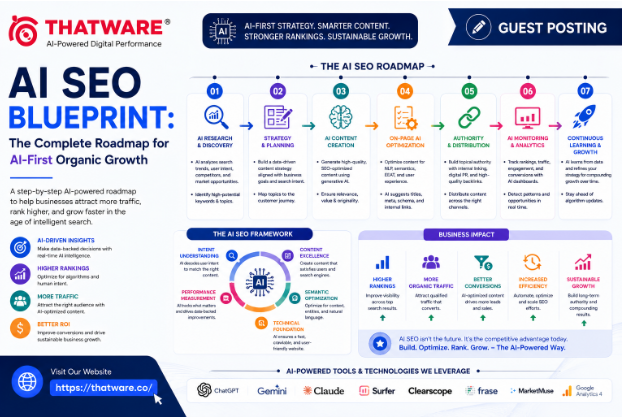
Building organic growth in 2026 without a structured approach is like trying to navigate a city without a map and no GPS. You’ll get somewhere eventually. You might even stumble across interesting things along the way. But you won’t get where you intended, and you’ll use a lot more resources than necessary.
A genuine AI-first SEO blueprint isn’t a collection of tactics. It’s an architecture — a connected set of systems that work together, inform each other, and compound over time. This is what separates organizations that build sustainable organic traffic from those that perpetually chase whatever tactic the SEO community is discussing this month.
Phase One: Intelligence Foundation
Before any optimization work begins, an AI-first approach requires building the intelligence infrastructure that will inform every subsequent decision. This phase is often skipped or compressed in traditional SEO, which jumps straight from “here are our target keywords” to “here’s a content plan.” That shortcut is why so many content strategies produce mediocre results despite significant production investment.
The intelligence foundation involves three components. First, semantic landscape mapping — using NLP analysis to understand how your topic space is structured, what entities and relationships define it, how search intent is distributed across query types, and where competitive gaps exist. This is the map of the territory, not just a list of coordinates.
Second, domain authority analysis — not just your DA score but your actual topical authority profile: where does your site already have established relevance signals, where are you starting from scratch, and what does the realistic competitive trajectory look like for different topic areas?
Third, behavioral signal profiling — understanding how users in your specific niche search, refine, click, and engage. Aggregate behavioral data from your analytics combined with industry-level behavioral patterns creates a much clearer picture of intent than search volume alone.
Phase Two: Technical Infrastructure
Technical SEO in an AI-first blueprint isn’t a preliminary checklist — it’s an ongoing system. The key difference from traditional approaches is prioritization methodology.
AI SEO blueprint services use predictive modeling to rank technical issues by expected ranking impact rather than severity category. A crawl budget issue affecting 40,000 pages in a high-traffic section of the site gets higher priority than a structured data error on fifty product pages, even if the latter shows as “critical” in a crawl tool. The prioritization is based on organic traffic potential, not error taxonomy.
The technical layer also sets the foundation for everything else. Crawlability, indexation health, Core Web Vitals, mobile performance, and structured data aren’t optional — they determine whether all the content and link-building work above can actually have its intended effect.
Phase Three: Content Architecture
Content in an AI-first strategy is built as architecture, not as a series of individual pieces. The blueprint starts with pillar content — comprehensive resources that establish authority on the core topics your business needs to own — and builds topical clusters around them systematically.
AI SEO for higher rankings requires content that earns authority signals by being genuinely comprehensive within a topic domain. Each cluster builds coverage of a conceptual neighborhood: main pillar, supporting subtopic content, FAQ and question-based content, comparison content, and deep-dive subject matter content. Together, the cluster signals topical expertise much more powerfully than individual pages optimized for individual keywords.
AI tools inform what the cluster needs to contain — which entities to establish, which intent variants to address, what depth is required to be competitive — while human expertise provides the perspective and insight that makes the content worth reading.
Phase Four: Authority Building
Link acquisition in an AI-first blueprint is guided by semantic relevance analysis rather than just domain authority scores. Not all links contribute equally to ranking for specific queries — contextual relevance between the linking page and the content topic matters significantly. An AI-informed link strategy identifies where topically relevant links exist, which gaps in your link profile are most limiting for specific ranking targets, and what content assets would naturally attract links in your specific competitive landscape.
This phase also includes entity authority building — ensuring your brand and key individuals appear as recognized entities in Google’s knowledge graph through structured data, Wikipedia presence, authoritative citations, and consistent entity disambiguation across all your web properties.
Phase Five: Continuous Optimization
This is where the AI-first blueprint diverges most sharply from traditional project-based SEO. The system doesn’t end with publishing. It monitors continuously, flags decay signals, identifies emerging opportunities, and feeds data back into all preceding phases.
Pages showing early ranking decay get prioritized for refresh before they lose significant traffic. Topic areas gaining search momentum get flagged for content expansion. Technical performance changes get analyzed for correlation with ranking fluctuations. The whole system learns.
This continuous optimization loop is what produces compounding returns over time — not by doing more work, but by doing smarter work guided by a progressively more accurate model of what actually drives organic growth in your specific context.